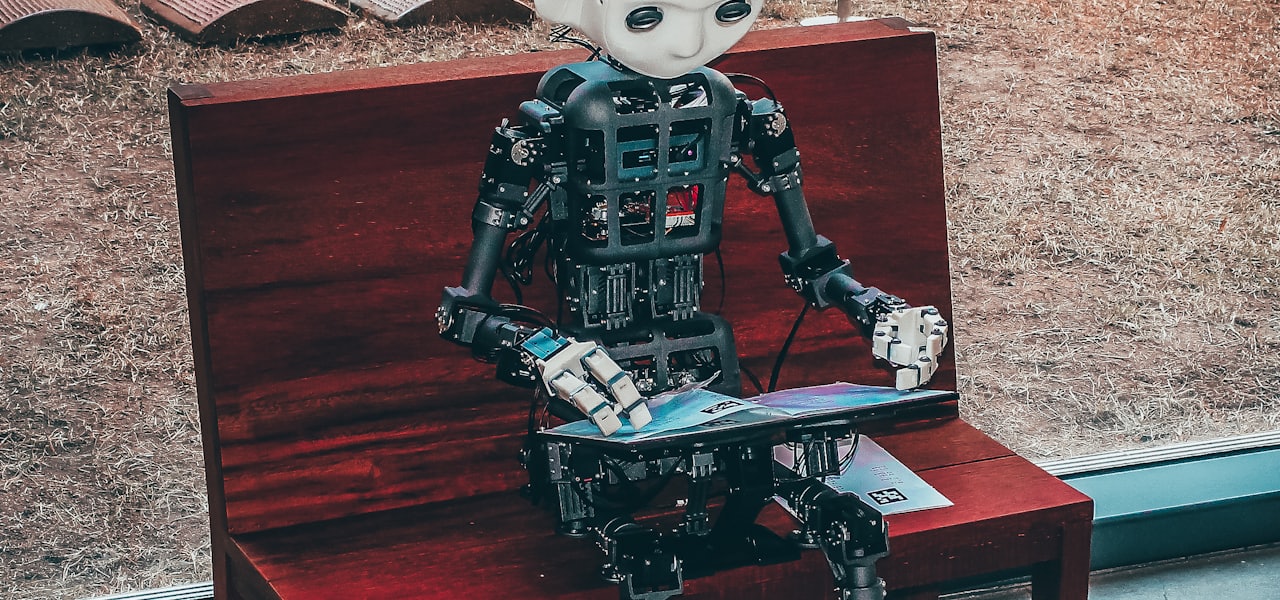
Robotics is the branch of technology that deals with the design, construction, operation, structural disposition, manufacture and application of robots. Robotics is related to the sciences of electronics, engineering, mechanics, and software. The following is a list of common definitions related to the Robotics field. == A == Actuator: a motor that translates control signals into mechanical movement. The control signals are usually electrical but may, more rarely, be pneumatic or hydraulic. The power supply may likewise be any of these. It is common for electrical control to be used to modulate a high-power pneumatic or hydraulic motor. Aerobot: a robot capable of independent flight on other planets. A type of aerial robot. Arduino: The current platform of choice for small-scale robotic experimentation and physical computing. Artificial intelligence: is the intelligence of machines and the branch of computer science that aims to create it. Aura (satellite): a robotic spacecraft launched by NASA in 2004 which collects atmospheric data from Earth. Automaton: an early self-operating robot, performing exactly the same actions, over and over. Autonomous vehicle: a vehicle equipped with an autopilot system, which is capable of driving from one point to another without input from a human operator. == B == Biomimetic: See Bionics. Bionics: also known as biomimetics, biognosis, biomimicry, or bionical creativity engineering is the application of biological methods and systems found in nature to the study and design of engineering systems and modern technology. == C == CAD/CAM (computer-aided design and computer-aided manufacturing): These systems and their data may be integrated into robotic operations. Čapek, Karel: Czech author who coined the term 'robot' in his 1921 play, Rossum's Universal Robots. Chandra X-ray Observatory: a robotic spacecraft launched by NASA in 1999 to collect astronomical data. Cloud robotics: robots empowered with more capacity and intelligence from cloud. Combat, robot: a hobby or sport event where two or more robots fight in an arena to disable each other. This has developed from a hobby in the 1990s to several TV series worldwide. Cruise missile: a robot-controlled guided missile that carries an explosive payload. Cyborg: also known as a cybernetic organism, a being with both biological and artificial (e.g. electronic, mechanical or robotic) parts. == D == Degrees of freedom: the extent to which a robot can move itself; expressed in terms of Cartesian coordinates (x, y, and z) and angular movements (yaw, pitch, and roll). Delta robot: a tripod linkage, used to construct fast-acting manipulators with a wide range of movement. Drive Power: The energy source or sources for the robot actuators. == E == Emergent behaviour, a complicated resultant behaviour that emerges from the repeated operation of simple underlying behaviours. Envelope (Space), Maximum The volume of space encompassing the maximum designed movements of all robot parts including the end-effector, workpiece, and attachments. Explosive ordnance disposal robot A mobile robot designed to assess whether an object contains explosives; some carry detonators that can be deposited at the object and activated after the robot withdraws. == F == FIRST(For Inspiration and Recognition of Science and Technology): an organization founded by inventor Dean Kamen in 1989 in order to develop ways to inspire students in engineering and technology fields. Forward chaining: a process in which events or received data are considered by an entity to intelligently adapt its behavior. == G == Gynoid: A humanoid robot designed to look like a human female. == H == Haptic: tactile feedback technology using the operator's sense of touch. Also sometimes applied to robot manipulators with their own touch sensitivity. Hexapod (platform): A movable platform using six linear actuators. Often used in flight simulators and fairground rides, they also have applications as a robotic manipulator. Hexapod (walker): A six-legged walking robot, using a simple insect-like locomotion. Human–computer interaction. Humanoid: A robotic entity designed to resemble a human being in form, function, or both. Hydraulics: the control of mechanical force and movement, generated by the application of liquid under pressure. cf. pneumatics. == I == Industrial robot: A reprogrammable, multifunctional manipulator designed to move material, parts, tools, or specialized devices through variable programmed motions for the performance of a variety of tasks. Insect robot: A small robot designed to imitate insect behaviors rather than complex human behaviors. == K == Kalman filter: a mathematical technique to estimate the value of a sensor measurement, from a series of intermittent and noisy values. Kinematics: the study of motion, as applied to robots. This includes both the design of linkages to perform motion, their power, control and stability; also their planning, such as choosing a sequence of movements to achieve a broader task. Inverse Kinematics: the process of determining joint angles required for a robot's end-effector to reach a desired position and orientation in space. Used in motion planning to calculate motor commands from target positions. == L == Linear actuator A form of motor that generates a linear movement directly. == M == Manipulator or gripper: A robotic 'hand'. Mobile robot: A self-propelled and self-contained robot that is capable of moving over a mechanically unconstrained course. Muting: The deactivation of a presence-sensing safeguarding device during a portion of the robot cycle. Mecanum wheel: A wheel fitted with angled rollers that enables a robot vehicle to move in multiple directions, including sideways. == O == Ornithopter – An aerial robot or drone that achieves flight through a flapping-wing mechanism rather than rotating blades or fixed wings, often utilized for highly maneuverable flight. == P == Parallel manipulator: an articulated robot or manipulator based on a number of kinematic chains, actuators and joints, in parallel. cf. serial manipulator. Pendant: Any portable control device that permits an operator to control the robot from within the restricted envelope (space) of the robot. Pneumatics: the control of mechanical force and movement, generated by the application of compressed gas. cf. hydraulics. Powered exoskeleton: is a wearable mobile machine that allow for limb movement with increased strength and endurance. Prosthetic robots: programmable manipulators or devices for missing human limbs. == R == Remote manipulator: A manipulator under direct human control, often used for work with hazardous materials. Robonaut: a development project conducted by NASA to create humanoid robots capable of using space tools and working in similar environments to suited astronauts. == S == Sensor fusion:The process of combining data from multiple sensors, such as LiDAR, cameras, global positioning systems (GPS), and inertial measurement units (IMUs), to produce a more accurate and reliable understanding of an environment than using a single sensor alone. It is widely used in robotics and autonomous systems to improve perception, localization, and decision-making. Serial manipulator: an articulated robot or manipulator with a single series kinematic chain of actuators. cf. parallel manipulator. Service robots are machines that extend human capabilities. Servo, a motor that moves to and maintains a set position under command, rather than continuously moving. Servomechanism An automatic device that uses error-sensing negative feedback to correct the performance of a mechanism. Single Point of Control The ability to operate the robot such that initiation or robot motion from one source of control is possible only from that source and cannot be overridden from another source. Slow Speed Control A mode of robot motion control where the velocity of the robot is limited to allow persons sufficient time either to withdraw the hazardous motion or stop the robot. Snake robot A robot component resembling a tentacle or elephant's trunk, where many small actuators are used to allow continuous curved motion of a robot component, with many degrees of freedom. This is usually applied to snake-arm robots, which use this as a flexible manipulator. A rarer application is the snakebot, where the entire robot is mobile and snake-like, so as to gain access through narrow spaces. Stepper motor Stewart platform A movable platform using six linear actuators, hence also known as a Hexapod. Subsumption architecture A robot architecture that uses a modular, bottom-up design beginning with the least complex behavioral tasks. Surgical robot, a remote manipulator used for keyhole surgery Swarm robotics involve large numbers of mostly simple physical robots. Their actions may seek to incorporate emergent behavior observed in social insects (swarm intelligence). Synchro == T == Teach Mode: The control state that al
Racter
Racter is an artificial intelligence program that generates English language prose at random. It was published by Mindscape for IBM PC compatibles in 1984, then for the Apple II, Mac, and Amiga. An expanded version of the software, not the one released through Mindscape, was used to generate the text for the published book The Policeman's Beard Is Half Constructed. == History == Racter, short for raconteur, was written by William Chamberlain and Thomas Etter. Racter's initial creation was the short story Soft Ions, which appeared in the October 1981 issue of Omni (magazine). The publication's editors bought the story in January 1980, before it had even been written. In exchange for the rights, the editors offered financial support to Chamberlain and Etter so the two could refine Racter. In 1983, Racter produced a book called The Policeman's Beard Is Half Constructed (ISBN 0-446-38051-2). The program originally was written for an OSI which only supported file names at most six characters long, causing the name to be shorted to Racter and it was later adapted to run on a CP/M machine where it was written in "compiled ASIC on a Z80 microcomputer with 64K of RAM." This version, the program that allegedly wrote the book, was not released to the general public. The sophistication claimed for the program was likely exaggerated, as could be seen by investigation of the template system of text generation. In 1984, Mindscape released an interactive version of Racter, developed by Inrac Corporation, for IBM PC compatibles, and it was ported to the Apple II, Mac, and Amiga. The published Racter was similar to a chatterbot. The BASIC program that was released by Mindscape was far less sophisticated than anything that could have written the fairly sophisticated prose of The Policeman's Beard. The commercial version of Racter could be likened to a computerized version of Mad Libs, the game in which you fill in the blanks in advance and then plug them into a text template to produce a surrealistic tale. The commercial program attempted to parse text inputs, identifying significant nouns and verbs, which it would then regurgitate to create "conversations", plugging the input from the user into phrase templates which it then combined, along with modules that conjugated English verbs. By contrast, the text in The Policeman's Beard, apart from being edited from a large amount of output, would have been the product of Chamberlain's own specialized templates and modules, which were not included in the commercial release of the program. == Reception == The Boston Phoenix called the story Soft Ions "schematic nonsense. But the scheme is obvious enough and the nonsense accessible enough to an attentive reader that one can almost believe Chamberlain when he predicts that before long Racter will be ready to write for the pulp-reading public." PC Magazine described some of Policeman's Beard's scenes as "surprising for their frankness" and "reflective". It concluded that the book was "whimsical and wise and sometimes fun". Computer Gaming World described Racter as "a diversion into another dimension that might best be seen before paying the price of a ticket. (Try before you buy!)" A 1985 review of the program in The New York Times notes that, "As computers move ever closer to artificial intelligence, Racter is on the edge of artificial insanity." It also states that Racter's "always-changing sentences are grammatically correct, often funny and, for a computer, sometimes profound." The article includes examples showing interaction with Racter, most often Racter asking the user questions. == Reviews == Jeux & Stratégie #47
Jean Véronis
Jean Véronis (3 June 1955 – 8 September 2013) was a French linguist, computer scientist and blogger, and a research professor at Aix-Marseille University. His research interests included natural language processing, text mining and standardisation. He was a founder of the field that is now called digital humanities. In 2006, his blog was listed among the 15 most influential by Le Monde.
Marius Lindauer
Marius Lindauer (born December 25, 1985, in Berlin, Germany) is a German computer scientist and professor of machine learning at the institute of artificial intelligence of the Leibniz University Hannover. He is known for his research on Automated Machine Learning and other meta-algorithmic approaches. == Life == Marius Lindauer studied computer science at the University of Potsdam from 2005 to 2010. Under the supervision of Torsten Schaub and Holger Hoos, he received his Dr. rer. nat. at the University of Potsdam in 2015. In 2014, he joined the Machine Learning research lab led by Frank Hutter as the first postdoctoral researcher and helped to build up the group. He then joined the Leibniz University Hannover as a professor in 2019 to lead the Machine learning research lab. He founded the Institute of Artificial Intelligence at the Leibniz University Hannover in 2022. Additionally, he is the co-head of the automl.org research group, automl.space community effort, and co-founder of the COSEAL research network, where he currently serves as an advisory board member. He is also a supporting member of CLAIRE, and a member of ELLIS. His research is published in renowned journals and conferences. == Achievements == During his Ph.D., Marius won several international competitions in the fields of solving hard combinatorial optimization problems, including 1st place in the NP-track of the answer set programming competition 2011 with claspfolio, the Hard Combinatorial SAT+UNSAT of the SAT challenge 2012 with clasp-crafted and two tracks of the configurable SAT solver challenge 2013 with clasp-cssc. During his PostDoc and later on, he was involved in winning tracks of the first and second AutoML challenge with auto-sklearn and the black-box optimization challenge for machine learning at NeurIPS'20. == Research Directions == Marius has delved into many research topics, all of which are unified under the umbrella of automating parts of the Machine Learning pipeline. His research touches many different aspects: Hyperparameter Optimization Multi-Fidelity Optimization Automated Reinforcement Learning Interactive AutoML Green AutoML Explainable AutoML
Tom M. Mitchell
Tom Michael Mitchell (born August 9, 1951) is an American computer scientist and the Founders University Professor at Carnegie Mellon University (CMU). He is a founder and former chair of the Machine Learning Department at CMU. Mitchell is known for his contributions to the advancement of machine learning, artificial intelligence, and cognitive neuroscience and is the author of the textbook Machine Learning. He is a member of the United States National Academy of Engineering since 2010. He is also a Fellow of the American Academy of Arts and Sciences, the American Association for the Advancement of Science and a Fellow and past president of the Association for the Advancement of Artificial Intelligence. In October 2018, Mitchell was appointed as the Interim Dean of the School of Computer Science at Carnegie Mellon. == Early life and education == Mitchell was born in Blossburg, Pennsylvania and grew up in Upstate New York, in the town of Vestal. He received his bachelor of Science degree in electrical engineering from the Massachusetts Institute of Technology in 1973 and a Ph.D. from Stanford University under the direction of Bruce G. Buchanan in 1979. == Career == Mitchell began his teaching career at Rutgers University in 1978. During his tenure at Rutgers, he held the positions of assistant and associate professor in the Department of Computer Science. In 1986, he left Rutgers and joined Carnegie Mellon University, Pittsburgh as a professor. In 1999, he became the E. Fredkin Professor in the School of Computer Science. In 2006 Mitchell was appointed as the first chair of the Machine Learning Department within the School of Computer Science. He became university professor in 2009, and served as Interim Dean of the Carnegie Mellon School of Computer Science during 2018–2019. Mitchell currently serves on the Scientific Advisory Board of the Allen Institute for AI and on the Science Board of the Santa Fe Institute. == Honors and awards == He was elected into the United States National Academy of Engineering in 2010 "for pioneering contributions and leadership in the methods and applications of machine learning." He is also a Fellow of the American Association for the Advancement of Science (AAAS) since 2008 and a Fellow the Association for the Advancement of Artificial Intelligence (AAAI) since 1990. In 2016 he became a Fellow of the American Academy of Arts and Sciences. Mitchell was awarded an Honorary Doctor of Laws degree from Dalhousie University in 2015 for his contributions to machine learning and to cognitive neuroscience, and the President's Medal from Stevens Institute of Technology in 2018. He is a recipient of the NSF Presidential Young Investigator Award in 1984. == Publications == Mitchell is a prolific author of scientific works on various topics in computer science, including machine learning, artificial intelligence, robotics, and cognitive neuroscience. He has authored hundreds of scientific articles. Mitchell published one of the first textbooks in machine learning, entitled Machine Learning, in 1997 (publisher: McGraw Hill Education). He is also a coauthor of the following books: J. Franklin, T. Mitchell, and S. Thrun (eds.), Recent Advances in Robot Learning, Kluwer Academic Publishers, 1996. T. Mitchell, J. Carbonell, and R. Michalski (eds.), Machine Learning: A Guide to Current Research, Kluwer Academic Publishers, 1986. R. Michalski, J. Carbonell, and T. Mitchell (eds.), Machine Learning: An Artificial Intelligence Approach, Volume 2, Morgan Kaufmann, 1986. R. Michalski, J. Carbonell, and T. Mitchell (eds.), Machine Learning: An Artificial Intelligence Approach, Tioga Press, 1983.
Comparison of video editing software
This is a comparison of non-linear video editing software applications. See also a more complete list of video editing software. == General information == This table gives basic general information about the different editors: === Active === === Discontinued / Inactive === ==== Definition ==== professional: used for full length Hollywood movies; professional (small): mainly used for paid commercials, short films or podcasts/YouTube channels; prosumer: Mainly targeting private use, anything that can do more than just trimming a film; basic: trimming a film; == System requirements == This table lists the operating systems that different editors can run on without emulation, as well as other system requirements. Note that minimum system requirements are listed; some features (like High Definition support) may be unavailable with these specifications. "Unix" includes the similar Linux, BSD and Unix-like operating systems. == High definition/High resolution import == The table below indicates the ability of each program to import various High Definition video or High resolution video formats for editing. == Feature set == == Output options == Please note that recording to Blu-ray does not imply 1080@50p/60p . Most only support up to 1080i 25/30 frames per second recording. Also not all formats can be output.
Structured support vector machine
The structured supportvector machine is a machine learning algorithm that generalizes the support vector machine (SVM) classifier. Whereas the SVM classifier supports binary classification, multiclass classification and regression, the structured SVM allows training of a classifier for general structured output labels. As an example, a sample instance might be a natural language sentence, and the output label is an annotated parse tree. Training a classifier consists of showing pairs of correct sample and output label pairs. After training, the structured SVM model allows one to predict for new sample instances the corresponding output label; that is, given a natural language sentence, the classifier can produce the most likely parse tree. == Training == For a set of n {\displaystyle n} training instances ( x i , y i ) ∈ X × Y {\displaystyle ({\boldsymbol {x}}_{i},y_{i})\in {\mathcal {X}}\times {\mathcal {Y}}} , i = 1 , … , n {\displaystyle i=1,\dots ,n} from a sample space X {\displaystyle {\mathcal {X}}} and label space Y {\displaystyle {\mathcal {Y}}} , the structured SVM minimizes the following regularized risk function. min w ‖ w ‖ 2 + C ∑ i = 1 n max y ∈ Y ( 0 , Δ ( y i , y ) + ⟨ w , Ψ ( x i , y ) ⟩ − ⟨ w , Ψ ( x i , y i ) ⟩ ) {\displaystyle {\underset {\boldsymbol {w}}{\min }}\quad \|{\boldsymbol {w}}\|^{2}+C\sum _{i=1}^{n}{\underset {y\in {\mathcal {Y}}}{\max }}\left(0,\Delta (y_{i},y)+\langle {\boldsymbol {w}},\Psi ({\boldsymbol {x}}_{i},y)\rangle -\langle {\boldsymbol {w}},\Psi ({\boldsymbol {x}}_{i},y_{i})\rangle \right)} The function is convex in w {\displaystyle {\boldsymbol {w}}} because the maximum of a set of affine functions is convex. The function Δ : Y × Y → R + {\displaystyle \Delta :{\mathcal {Y}}\times {\mathcal {Y}}\to \mathbb {R} _{+}} measures a distance in label space and is an arbitrary function (not necessarily a metric) satisfying Δ ( y , z ) ≥ 0 {\displaystyle \Delta (y,z)\geq 0} and Δ ( y , y ) = 0 ∀ y , z ∈ Y {\displaystyle \Delta (y,y)=0\;\;\forall y,z\in {\mathcal {Y}}} . The function Ψ : X × Y → R d {\displaystyle \Psi :{\mathcal {X}}\times {\mathcal {Y}}\to \mathbb {R} ^{d}} is a feature function, extracting some feature vector from a given sample and label. The design of this function depends very much on the application. Because the regularized risk function above is non-differentiable, it is often reformulated in terms of a quadratic program by introducing one slack variable ξ i {\displaystyle \xi _{i}} for each sample, each representing the value of the maximum. The standard structured SVM primal formulation is given as follows. min w , ξ ‖ w ‖ 2 + C ∑ i = 1 n ξ i s.t. ⟨ w , Ψ ( x i , y i ) ⟩ − ⟨ w , Ψ ( x i , y ) ⟩ + ξ i ≥ Δ ( y i , y ) , i = 1 , … , n , ∀ y ∈ Y {\displaystyle {\begin{array}{cl}{\underset {{\boldsymbol {w}},{\boldsymbol {\xi }}}{\min }}&\|{\boldsymbol {w}}\|^{2}+C\sum _{i=1}^{n}\xi _{i}\\{\textrm {s.t.}}&\langle {\boldsymbol {w}},\Psi ({\boldsymbol {x}}_{i},y_{i})\rangle -\langle {\boldsymbol {w}},\Psi ({\boldsymbol {x}}_{i},y)\rangle +\xi _{i}\geq \Delta (y_{i},y),\qquad i=1,\dots ,n,\quad \forall y\in {\mathcal {Y}}\end{array}}} == Inference == At test time, only a sample x ∈ X {\displaystyle {\boldsymbol {x}}\in {\mathcal {X}}} is known, and a prediction function f : X → Y {\displaystyle f:{\mathcal {X}}\to {\mathcal {Y}}} maps it to a predicted label from the label space Y {\displaystyle {\mathcal {Y}}} . For structured SVMs, given the vector w {\displaystyle {\boldsymbol {w}}} obtained from training, the prediction function is the following. f ( x ) = argmax y ∈ Y ⟨ w , Ψ ( x , y ) ⟩ {\displaystyle f({\boldsymbol {x}})={\underset {y\in {\mathcal {Y}}}{\textrm {argmax}}}\quad \langle {\boldsymbol {w}},\Psi ({\boldsymbol {x}},y)\rangle } Therefore, the maximizer over the label space is the predicted label. Solving for this maximizer is the so-called inference problem and similar to making a maximum a-posteriori (MAP) prediction in probabilistic models. Depending on the structure of the function Ψ {\displaystyle \Psi } , solving for the maximizer can be a hard problem. == Separation == The above quadratic program involves a very large, possibly infinite number of linear inequality constraints. In general, the number of inequalities is too large to be optimized over explicitly. Instead the problem is solved by using delayed constraint generation where only a finite and small subset of the constraints is used. Optimizing over a subset of the constraints enlarges the feasible set and will yield a solution that provides a lower bound on the objective. To test whether the solution w {\displaystyle {\boldsymbol {w}}} violates constraints of the complete set inequalities, a separation problem needs to be solved. As the inequalities decompose over the samples, for each sample ( x i , y i ) {\displaystyle ({\boldsymbol {x}}_{i},y_{i})} the following problem needs to be solved. y n ∗ = argmax y ∈ Y ( Δ ( y i , y ) + ⟨ w , Ψ ( x i , y ) ⟩ − ⟨ w , Ψ ( x i , y i ) ⟩ − ξ i ) {\displaystyle y_{n}^{}={\underset {y\in {\mathcal {Y}}}{\textrm {argmax}}}\left(\Delta (y_{i},y)+\langle {\boldsymbol {w}},\Psi ({\boldsymbol {x}}_{i},y)\rangle -\langle {\boldsymbol {w}},\Psi ({\boldsymbol {x}}_{i},y_{i})\rangle -\xi _{i}\right)} The right hand side objective to be maximized is composed of the constant − ⟨ w , Ψ ( x i , y i ) ⟩ − ξ i {\displaystyle -\langle {\boldsymbol {w}},\Psi ({\boldsymbol {x}}_{i},y_{i})\rangle -\xi _{i}} and a term dependent on the variables optimized over, namely Δ ( y i , y ) + ⟨ w , Ψ ( x i , y ) ⟩ {\displaystyle \Delta (y_{i},y)+\langle {\boldsymbol {w}},\Psi ({\boldsymbol {x}}_{i},y)\rangle } . If the achieved right hand side objective is smaller or equal to zero, no violated constraints for this sample exist. If it is strictly larger than zero, the most violated constraint with respect to this sample has been identified. The problem is enlarged by this constraint and resolved. The process continues until no violated inequalities can be identified. If the constants are dropped from the above problem, we obtain the following problem to be solved. y i ∗ = argmax y ∈ Y ( Δ ( y i , y ) + ⟨ w , Ψ ( x i , y ) ⟩ ) {\displaystyle y_{i}^{}={\underset {y\in {\mathcal {Y}}}{\textrm {argmax}}}\left(\Delta (y_{i},y)+\langle {\boldsymbol {w}},\Psi ({\boldsymbol {x}}_{i},y)\rangle \right)} This problem looks very similar to the inference problem. The only difference is the addition of the term Δ ( y i , y ) {\displaystyle \Delta (y_{i},y)} . Most often, it is chosen such that it has a natural decomposition in label space. In that case, the influence of Δ {\displaystyle \Delta } can be encoded into the inference problem and solving for the most violating constraint is equivalent to solving the inference problem.