Social trading is a form of investing that allows investors to observe the trading behavior of their peers and expert traders. The primary objective is to follow their investment strategies using copy trading or mirror trading. Social trading requires little or no knowledge about financial markets. == History == One of the first social trading platforms was Collective2] which began offering a social trading functionality to retail traders as early as 2003 (preceding ZuluTrade by four years). In 2010, social trading started to achieve a greater degree of mainstream appeal with eToro, followed by Wikifolio in 2012. Europe-based NAGA, listed on Frankfurt Stock Exchange since 2017, claims more than EUR 27 billion was traded on its platform in the second half of 2019. Some of the other contemporary social trading platforms and tech providers are Trading Motion, Brokeree Solutions, iSystems, and FX Junction, among others. === Research === MIT Computer Scientist and researcher Yaniv Altshuler described social trading networks as complex adaptive systems, and in his 2014 research on eToro's OpenBook, wrote that "Having the inherent ability to share ideas and information between each others, OpenBook's users are given a new source of information they can use in order to enhance their trading performance. As the users are not playing against each other but rather – against the market, this situation becomes a non zero-sum game, hence incentivizing the users to share as much information as possible." His paper concludes that "social trading provides much better opportunities for profiting compared with individual trading," but that users make "excellent but sometimes not optimal decisions in selecting experts when they can see others' choices." A 2015 World Economic Forum report described social trading networks as disruptors, which "have emerged to provide low-cost, sophisticated alternatives to traditional wealth managers. These solutions cater to a broader customer base and empower customers to have more control of their wealth management," and "pose a tangible threat to the traditional practices of the wealth management industry". Economist Nouriel Roubini's thinktank predicted in 2016 that "newer forms of investment, such as socially responsible investments and social trading will bring some of the largest industry growth in the coming years." A 2017 St. John's University study found that 'leader' traders, or those with followers, are more susceptible to the disposition effect than investors that are not being followed by any other traders, with the authors suggesting the observation may be explained by "leaders feeling responsible towards their followers and an urge to not let them down, by fear of losing followers when admitting a bad investment decision and signaling confidence in their initial investment choice, or by an attempt of newly appointed leaders to manage their self-image." Social trading may potentially also change how much risk investors take. A recent experimental study argues that merely providing information on the success of others may lead to a significant increase in risk taking. This increase in risk taking may even be larger when subjects are provided with the option to directly copy others. == Characteristics == Social trading is an alternative way of analyzing financial data by looking at what other traders are doing and comparing and copying their techniques and strategies. Prior to the advent of social trading, investors and traders were relying on fundamental or technical analysis to form their investment decisions. Using social trading investors and traders could integrate into their investment decision-process social indicators from trading data-feeds of other traders. Social trading platforms or networks can be considered a subcategory of social networking services. Social trading allows traders to trade online with the help of others and some have claimed shortens the learning curve from novice to experienced trader. Traders can interact with others, watch others take trades, then duplicate their trades and learn what prompted the top performer to take a trade in the first place. By copying trades, traders can learn which strategies work and which do not work. Social trading is used to do speculation; in the moral context speculative practices are considered negatively and to be avoided by each individual. who conversely should maintain a long-term horizon avoiding any types of short term speculation. Social Media has permeated the trading world such that two main types of trading has evolved: Traditional Trades Single (or non-social) trade: Trader A places a normal trade by himself or herself; This can by manual or automated Social Trading There are two main types of social trading: Copy trade: Trader A places exactly the same trade as trader B's one single trade; (iii) Mirror trade: Trader A automatically executes trader B's every single trade, i.e., trader A follows exactly trader B's trading activities. Other variations offered on some platforms allow users to copy another trader's portfolio (copy portfolio), and follow a trader's dividends (copy dividends), where whenever a followed trader withdraws money from his or her account, a proportional amount of money will be withdrawn from the balance of their follower, in real time. === Key features === Information flow: Unencumbered access to information is important in financial markets and that makes the free exchange of information of interest to small scale as well as individual investors. Cooperative trading: Social trading offers traders the opportunity to work together in trading teams which can trade the markets collaboratively, whether by pooling funds, dividing research or through sharing information. Monetization: As with social networks in the broader sense, monetization strategies are not always clear. As with social networks in general, it is possible, however, that the long-term worth of such websites may come from the variety and depth of data about their users which their active communities are likely to generate. Transparency: Social trading platforms reveal traders' performance stats, open and past positions, and market sentiment, giving members complete information to assess the credibility of the contributors they follow on the platform.
Data Science and Predictive Analytics
The first edition of the textbook Data Science and Predictive Analytics: Biomedical and Health Applications using R, authored by Ivo D. Dinov, was published in August 2018 by Springer. The second edition of the book was printed in 2023. This textbook covers some of the core mathematical foundations, computational techniques, and artificial intelligence approaches used in data science research and applications. By using the statistical computing platform R and a broad range of biomedical case-studies, the 23 chapters of the book first edition provide explicit examples of importing, exporting, processing, modeling, visualizing, and interpreting large, multivariate, incomplete, heterogeneous, longitudinal, and incomplete datasets (big data). == Structure == === First edition table of contents === The first edition of the Data Science and Predictive Analytics (DSPA) textbook is divided into the following 23 chapters, each progressively building on the previous content. === Second edition table of contents === The significantly reorganized revised edition of the book (2023) expands and modernizes the presented mathematical principles, computational methods, data science techniques, model-based machine learning and model-free artificial intelligence algorithms. The 14 chapters of the new edition start with an introduction and progressively build foundational skills to naturally reach biomedical applications of deep learning. Introduction Basic Visualization and Exploratory Data Analytics Linear Algebra, Matrix Computing, and Regression Modeling Linear and Nonlinear Dimensionality Reduction Supervised Classification Black Box Machine Learning Methods Qualitative Learning Methods—Text Mining, Natural Language Processing, and Apriori Association Rules Learning Unsupervised Clustering Model Performance Assessment, Validation, and Improvement Specialized Machine Learning Topics Variable Importance and Feature Selection Big Longitudinal Data Analysis Function Optimization Deep Learning, Neural Networks == Reception == The materials in the Data Science and Predictive Analytics (DSPA) textbook have been peer-reviewed in the Journal of the American Statistical Association, International Statistical Institute’s ISI Review Journal, and the Journal of the American Library Association. Many scholarly publications reference the DSPA textbook. As of January 17, 2021, the electronic version of the book first edition (ISBN 978-3-319-72347-1) is freely available on SpringerLink and has been downloaded over 6 million times. The textbook is globally available in print (hardcover and softcover) and electronic formats (PDF and EPub) in many college and university libraries and has been used for data science, computational statistics, and analytics classes at various institutions.
Alias Eclipse
Eclipse was a professional 2D image editing program available on Silicon Graphics and Windows workstations. Designed to manipulate high-resolution images like digitized movie frames and photographs for print, it offered color correction tools, image processing effects, rudimentary paint features, and spline-based drawing and masking. == History == Eclipse was originally developed in the late 1980s by Full Color Computing, an early provider of photo retouch and color prepress software for Silicon Graphics workstations. Alias Research (later Alias Systems Corporation), a developer of professional 3D graphics applications for the SGI platform, purchased the rights to Eclipse in fall 1990. Alias developed Eclipse through the early to mid-1990s, releasing version 2.5 in 1995 with improvements to the speed of color correction, effects, and rendering. Xyvision's Contex Prepress division purchased exclusive rights to Eclipse from Alias in 1996, and released version 3.0 the following year. Eclipse was subsequently sold to German developer Form & Vision GmbH, which continued development and ported it to the Windows platform. In 1999, Form & Vision released a demo of Eclipse 3.1.3 on the SGI platform which was limited to 1600 x 1600 pixel images, then ceased development of Eclipse on the SGI platform. Eclipse was thereafter developed exclusively for the Windows platform, culminating with version 3.1.4 in 2001. In the same year the firm went bankrupt. == Features == Eclipse was designed to work with very large images that could not be manipulated in real time on contemporary computer systems due to memory limitations, and thus allowed the user to make modifications to a lower-resolution copy of the original image in "proxy mode." Brush strokes, color corrections, and other edits were saved in proxy mode, then applied to the full-size image in post processing. This method also allowed for batch processing of a high-resolution image sequence using the edits applied to the original proxy image. Other features included color correction and separation, warping, special effects, text, and shape masking. Wavelet image compression created by LuraTech was added to Eclipse 3.1.4
Glossary of robotics
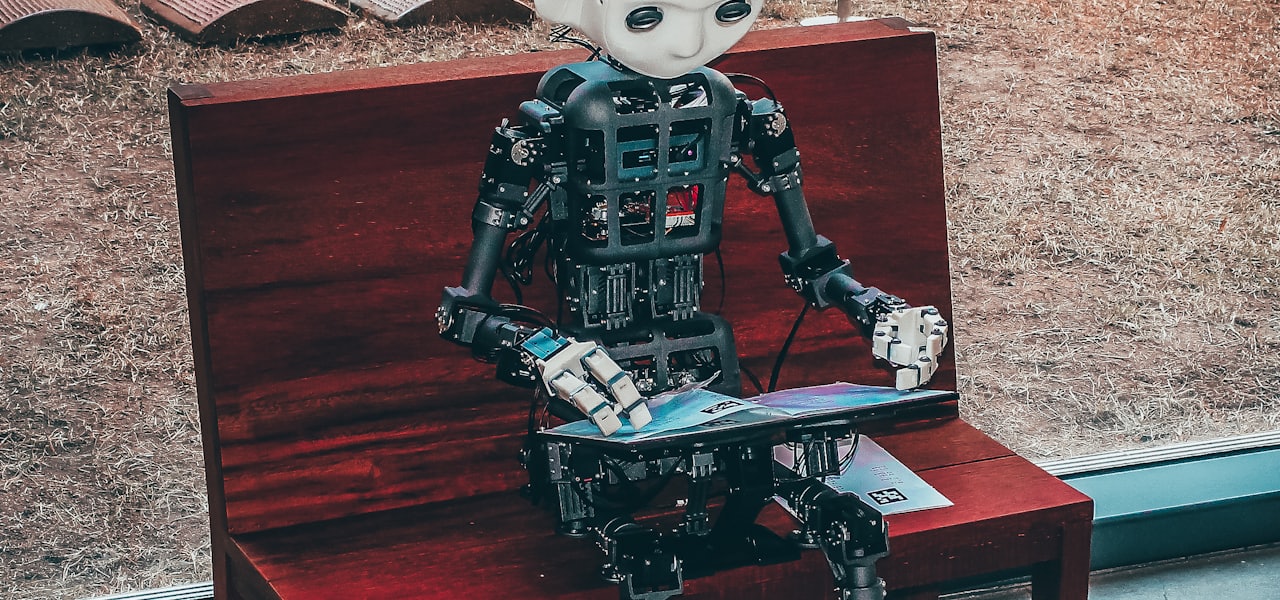
Robotics is the branch of technology that deals with the design, construction, operation, structural disposition, manufacture and application of robots. Robotics is related to the sciences of electronics, engineering, mechanics, and software. The following is a list of common definitions related to the Robotics field. == A == Actuator: a motor that translates control signals into mechanical movement. The control signals are usually electrical but may, more rarely, be pneumatic or hydraulic. The power supply may likewise be any of these. It is common for electrical control to be used to modulate a high-power pneumatic or hydraulic motor. Aerobot: a robot capable of independent flight on other planets. A type of aerial robot. Arduino: The current platform of choice for small-scale robotic experimentation and physical computing. Artificial intelligence: is the intelligence of machines and the branch of computer science that aims to create it. Aura (satellite): a robotic spacecraft launched by NASA in 2004 which collects atmospheric data from Earth. Automaton: an early self-operating robot, performing exactly the same actions, over and over. Autonomous vehicle: a vehicle equipped with an autopilot system, which is capable of driving from one point to another without input from a human operator. == B == Biomimetic: See Bionics. Bionics: also known as biomimetics, biognosis, biomimicry, or bionical creativity engineering is the application of biological methods and systems found in nature to the study and design of engineering systems and modern technology. == C == CAD/CAM (computer-aided design and computer-aided manufacturing): These systems and their data may be integrated into robotic operations. Čapek, Karel: Czech author who coined the term 'robot' in his 1921 play, Rossum's Universal Robots. Chandra X-ray Observatory: a robotic spacecraft launched by NASA in 1999 to collect astronomical data. Cloud robotics: robots empowered with more capacity and intelligence from cloud. Combat, robot: a hobby or sport event where two or more robots fight in an arena to disable each other. This has developed from a hobby in the 1990s to several TV series worldwide. Cruise missile: a robot-controlled guided missile that carries an explosive payload. Cyborg: also known as a cybernetic organism, a being with both biological and artificial (e.g. electronic, mechanical or robotic) parts. == D == Degrees of freedom: the extent to which a robot can move itself; expressed in terms of Cartesian coordinates (x, y, and z) and angular movements (yaw, pitch, and roll). Delta robot: a tripod linkage, used to construct fast-acting manipulators with a wide range of movement. Drive Power: The energy source or sources for the robot actuators. == E == Emergent behaviour, a complicated resultant behaviour that emerges from the repeated operation of simple underlying behaviours. Envelope (Space), Maximum The volume of space encompassing the maximum designed movements of all robot parts including the end-effector, workpiece, and attachments. Explosive ordnance disposal robot A mobile robot designed to assess whether an object contains explosives; some carry detonators that can be deposited at the object and activated after the robot withdraws. == F == FIRST(For Inspiration and Recognition of Science and Technology): an organization founded by inventor Dean Kamen in 1989 in order to develop ways to inspire students in engineering and technology fields. Forward chaining: a process in which events or received data are considered by an entity to intelligently adapt its behavior. == G == Gynoid: A humanoid robot designed to look like a human female. == H == Haptic: tactile feedback technology using the operator's sense of touch. Also sometimes applied to robot manipulators with their own touch sensitivity. Hexapod (platform): A movable platform using six linear actuators. Often used in flight simulators and fairground rides, they also have applications as a robotic manipulator. Hexapod (walker): A six-legged walking robot, using a simple insect-like locomotion. Human–computer interaction. Humanoid: A robotic entity designed to resemble a human being in form, function, or both. Hydraulics: the control of mechanical force and movement, generated by the application of liquid under pressure. cf. pneumatics. == I == Industrial robot: A reprogrammable, multifunctional manipulator designed to move material, parts, tools, or specialized devices through variable programmed motions for the performance of a variety of tasks. Insect robot: A small robot designed to imitate insect behaviors rather than complex human behaviors. == K == Kalman filter: a mathematical technique to estimate the value of a sensor measurement, from a series of intermittent and noisy values. Kinematics: the study of motion, as applied to robots. This includes both the design of linkages to perform motion, their power, control and stability; also their planning, such as choosing a sequence of movements to achieve a broader task. Inverse Kinematics: the process of determining joint angles required for a robot's end-effector to reach a desired position and orientation in space. Used in motion planning to calculate motor commands from target positions. == L == Linear actuator A form of motor that generates a linear movement directly. == M == Manipulator or gripper: A robotic 'hand'. Mobile robot: A self-propelled and self-contained robot that is capable of moving over a mechanically unconstrained course. Muting: The deactivation of a presence-sensing safeguarding device during a portion of the robot cycle. Mecanum wheel: A wheel fitted with angled rollers that enables a robot vehicle to move in multiple directions, including sideways. == O == Ornithopter – An aerial robot or drone that achieves flight through a flapping-wing mechanism rather than rotating blades or fixed wings, often utilized for highly maneuverable flight. == P == Parallel manipulator: an articulated robot or manipulator based on a number of kinematic chains, actuators and joints, in parallel. cf. serial manipulator. Pendant: Any portable control device that permits an operator to control the robot from within the restricted envelope (space) of the robot. Pneumatics: the control of mechanical force and movement, generated by the application of compressed gas. cf. hydraulics. Powered exoskeleton: is a wearable mobile machine that allow for limb movement with increased strength and endurance. Prosthetic robots: programmable manipulators or devices for missing human limbs. == R == Remote manipulator: A manipulator under direct human control, often used for work with hazardous materials. Robonaut: a development project conducted by NASA to create humanoid robots capable of using space tools and working in similar environments to suited astronauts. == S == Sensor fusion:The process of combining data from multiple sensors, such as LiDAR, cameras, global positioning systems (GPS), and inertial measurement units (IMUs), to produce a more accurate and reliable understanding of an environment than using a single sensor alone. It is widely used in robotics and autonomous systems to improve perception, localization, and decision-making. Serial manipulator: an articulated robot or manipulator with a single series kinematic chain of actuators. cf. parallel manipulator. Service robots are machines that extend human capabilities. Servo, a motor that moves to and maintains a set position under command, rather than continuously moving. Servomechanism An automatic device that uses error-sensing negative feedback to correct the performance of a mechanism. Single Point of Control The ability to operate the robot such that initiation or robot motion from one source of control is possible only from that source and cannot be overridden from another source. Slow Speed Control A mode of robot motion control where the velocity of the robot is limited to allow persons sufficient time either to withdraw the hazardous motion or stop the robot. Snake robot A robot component resembling a tentacle or elephant's trunk, where many small actuators are used to allow continuous curved motion of a robot component, with many degrees of freedom. This is usually applied to snake-arm robots, which use this as a flexible manipulator. A rarer application is the snakebot, where the entire robot is mobile and snake-like, so as to gain access through narrow spaces. Stepper motor Stewart platform A movable platform using six linear actuators, hence also known as a Hexapod. Subsumption architecture A robot architecture that uses a modular, bottom-up design beginning with the least complex behavioral tasks. Surgical robot, a remote manipulator used for keyhole surgery Swarm robotics involve large numbers of mostly simple physical robots. Their actions may seek to incorporate emergent behavior observed in social insects (swarm intelligence). Synchro == T == Teach Mode: The control state that al
Super-resolution imaging
Super-resolution imaging (SR) is a class of techniques that improve the resolution of an imaging system. In optical SR the diffraction limit of systems is transcended, while in geometrical SR the resolution of digital imaging sensors is enhanced. In some radar and sonar imaging applications (e.g. magnetic resonance imaging (MRI), high-resolution computed tomography), subspace decomposition-based methods (e.g. MUSIC) and compressed sensing-based algorithms (e.g., SAMV) are employed to achieve SR over standard periodogram algorithm. Super-resolution imaging techniques are used in general image processing and in super-resolution microscopy. == Super-resolution principles == Several concepts are fundamental to super-resolution imaging: Diffraction limit: the capacity of an optical instrument to reproduce the details of an object in an image has limits that are imposed by laws of physics: the diffraction equations in the wave theory of light, or the uncertainty principle for photons in quantum mechanics. Information transfer can never be increased beyond this boundary, but packets outside the limits can be cleverly swapped for (or multiplexed with) some inside it. Super-resolution microscopy does not so much “break” as “circumvent” the diffraction limit. New procedures probing electro-magnetic disturbances at the molecular level (in the so-called near field) remain fully consistent with Maxwell's equations. Spatial frequency domain: A succinct expression of the diffraction limit is given in the spatial frequency domain. In Fourier optics light distributions are expressed as superpositions of a series of grating light patterns in a range of fringe widths - these widths represent the spatial frequencies. It is generally taught that diffraction theory stipulates an upper limit, the cut-off spatial-frequency, beyond which pattern elements fail to be transferred into the optical image, i.e., are not resolved. But in fact what is set by diffraction theory is the width of the passband, not a fixed upper limit. No laws of physics are broken when a spatial frequency band beyond the cut-off spatial frequency is swapped for one inside it: this has long been implemented in dark-field microscopy. Nor are information-theoretical rules broken when superimposing several bands, disentangling them in the received image needs assumptions of object invariance during multiple exposures, i.e., the substitution of one kind of uncertainty for another. Information: When the term super-resolution is used in techniques based on the inference of object details using a statistical treatment of the image within standard resolution limits (for example, averaging multiple exposures), it involves an exchange of one kind of information (extracting signal from noise) for another (the assumption that the target has remained invariant). Recent breakthroughs incorporate quantum-transformer hybrids into super-resolution, such as QUIET‑SR, a 2025 model that employs shifted quantum window attention within a transformer to enhance image detail while respecting diffraction and information-theory limits Similarly, frequency-integrated transformers (e.g., FIT) enrich super-resolution by explicitly combining spatial and frequency-domain information via FFT-based attention, improving reconstruction across scales Resolution and localization: True resolution involves the distinction of whether a target, e.g. a star or a spectral line, is single or double, ordinarily requiring separable peaks in the image. When a target is known to be single, its location can be determined with higher precision than the image width by finding the centroid (center of gravity) of its image light distribution. The word ultra-resolution had been proposed for this process but it did not catch on, and the high-precision localization procedure is typically referred to as super-resolution. == Techniques == === Optical or diffractive super-resolution === Substituting spatial-frequency bands: Though the bandwidth allowable by diffraction is fixed, it can be positioned anywhere in the spatial-frequency spectrum. Dark-field illumination in microscopy is an example. See also aperture synthesis. ==== Multiplexing spatial-frequency bands ==== An image is formed using the normal passband of the optical device. Then, some known light structure (for example, a set of light fringes) is superimposed on the target. The image now contains components resulting from the combination of the target and the superimposed light structure, e.g. moiré fringes, and carries information about target detail which simple unstructured illumination does not. The “superresolved” components, however, need disentangling to be revealed. For an example, see structured illumination (figure to left). ==== Multiple parameter use within traditional diffraction limit ==== If a target has no special polarization or wavelength properties, two polarization states or non-overlapping wavelength regions can be used to encode target details, one in a spatial-frequency band inside the cut-off limit the other beyond it. Both would use normal passband transmission but are then separately decoded to reconstitute target structure with extended resolution. ==== Probing near-field electromagnetic disturbance ==== Super-resolution microscopy is generally discussed within the realm of conventional optical imagery. However, modern technology allows the probing of electromagnetic disturbance within molecular distances of the source, which has superior resolution properties. See also evanescent waves and the development of the new super lens. === Geometrical or image-processing super-resolution === ==== Multi-exposure image noise reduction ==== When an image is degraded by noise, the resolution may be improved by averaging multiple exposures. See example on the right. ==== Single-frame deblurring ==== Known defects in a given imaging situation, such as defocus or aberrations, can sometimes be mitigated in whole or in part by suitable spatial-frequency filtering of even a single image. Such procedures all stay within the diffraction-mandated passband, and do not extend it. ==== Sub-pixel image localization ==== The location of a single source can be determined by computing the "center of gravity" (centroid) of the light distribution extending over several adjacent pixels (see figure on the left). Provided that there is enough light, this can be achieved with arbitrary precision, very much better than pixel width of the detecting apparatus and the resolution limit for the decision of whether the source is single or double. This technique, which requires the presupposition that all the light comes from a single source, is at the basis of what has become known as super-resolution microscopy, e.g. stochastic optical reconstruction microscopy (STORM), where fluorescent probes attached to molecules give nanoscale distance information. It is also the mechanism underlying visual hyperacuity. ==== Bayesian induction beyond traditional diffraction limit ==== Some object features, though beyond the diffraction limit, may be known to be associated with other object features that are within the limits and hence contained in the image. Then conclusions can be drawn, using statistical methods, from the available image data about the presence of the full object. The classical example is Toraldo di Francia's proposition of judging whether an image is that of a single or double star by determining whether its width exceeds the spread from a single star. This can be achieved at separations well below the classical resolution bounds, and requires the prior limitation to the choice "single or double?" The approach can take the form of extrapolating the image in the frequency domain, by assuming that the object is an analytic function, and that we can exactly know the function values in some interval. This method is severely limited by the ever-present noise in digital imaging systems, but it can work for radar, astronomy, microscopy or magnetic resonance imaging. More recently, a fast single image super-resolution algorithm based on a closed-form solution to ℓ 2 − ℓ 2 {\displaystyle \ell _{2}-\ell _{2}} problems has been proposed and demonstrated to accelerate most of the existing Bayesian super-resolution methods significantly. == Aliasing == Geometrical SR reconstruction algorithms are possible if and only if the input low resolution images have been under-sampled and therefore contain aliasing. Because of this aliasing, the high-frequency content of the desired reconstruction image is embedded in the low-frequency content of each of the observed images. Given a sufficient number of observation images, and if the set of observations vary in their phase (i.e. if the images of the scene are shifted by a sub-pixel amount), then the phase information can be used to separate the aliased high-frequency content from the true low-frequency content, and the full-resolution image can be accurate
Synthesia (company)
Synthesia Limited is a British multinational artificial intelligence company based in London, United Kingdom. It is a synthetic media-generation software developer and creator of AI-generated video content, including audio-visual agents and cloned avatars. Britain's largest generative-AI firm, it is used by 70% of FTSE 100 and over 90% of Fortune 100 companies. == Overview == Synthesia is most often used by corporations for localized communication, orientation, employee training videos, advertising campaigns, reporting, product demonstrations, customer service, and to create chatbots. Its software algorithm mimics speech and facial movements based on video recordings of an individual’s speech and facial expressions. From this, a text-to-speech video is created to look and sound like the individual. Swiss bank UBS incorporated Synthesia AI-powered avatars of their human financial experts, for instance, in 2025. Users create content via the platform's pre-generated AI presenters or by creating digital representations of themselves, or personal avatars, using the platform's AI video editing tool. These avatars can be used to narrate videos generated from text. As of August 2021, Synthesia's voice database included multiple gender options in over 60 languages. Its free voice library doubled by 2025, to 140 languages and accents, and its Express-Voice technology can clone a user's own voice, or generate a synthetic one. === Deepfakes === The platform prohibits use of its software to create non-consensual clones, including of celebrities or political figures for satirical purposes. Explicit consent must be provided in addition to a strict pre-screening regimen for use of an individual's likeness to avoid “deepfaking”. While the company prohibits use of its technology for misinformation or "news-like content", an October 2023 Freedom House report stated that Synthesia tools had been used by governments in Venezuela, China, Burkina Faso, and Russia to create videos of fake TV news outlets with AI-generated avatars in order to spread propaganda. Actor Dan Dewhirst signed a contract with the company in 2021, becoming one of the first actors whose likeness would be made into an AI avatar, finding his likeness used in the Venezuelan generated-videos. The company stated, in February 2024, that it had improved its misuse detection systems, and, in April 2024, that new users of its technology are screened by the company, and content employing it is further vetted by Synthesia moderators. == History == Synthesia's software utilizes deep learning architecture developed by Lourdes Agapito and Matthias Niessner. The company was co-founded in 2017 by Agapito, Niessner, Victor Riparbelli, and Steffen Tjerrild. In 2018, the company first demonstrated the software's capabilities on the BBC programme Click when it presented a digitization of Matthew Amroliwala speaking Spanish, Mandarin, and Hindi. Through Synthesia's first two years of existence, it employed 10 people and struggled to make sales, leading to an expansion of the company's focus. It moved on from just targeting entertainment studios to a variety of businesses. In 2020, Synthesia users were reported to include Amazon, Tiffany & Co. and IHG Hotels & Resorts. In January 2024, the company introduced its AI video assistant, which turns text-to-video. That April, with a reported 55,000 customers, including half of the Fortune 100, Synthesia launched "expressive avatars". That September, an enhanced dubbing feature was launched, to translate video in 30 languages with naturalized lip-syncing. Peter Hill joined Synthesia as CTO in January 2025, following 25 years at Amazon, and two years as CEO and CPO of Wildfire Studios. That March, a million dollar base of shares was formed to furnish human actors, employed to generate digital avatars, with company stock, which all of its employees hold. By June of that year, 150,000 individuals from among Synthesia's 65,000 customers had created AI-generated avatars of themselves. In July 2025, the company's new global headquarters at Regent’s Place was opened by London mayor Sadiq Khan, who described Britain's largest generative-AI company, then valued at over $2 billion, as a "London success story". By that October, its technology was employed by 90% of the Fortune 100, and Synthesia 3.0 was launched, with hyper-realistic digital avatars equipped with AI-powered dubbing and translation, and a built-in video assistant. In January 2026, it reached a $4 billion valuation, with 70% of FTSE 100 companies noted among its customers. === Funding === The company raised $3.1 million in seed funding in 2019. In April 2021, the company raised $12.5 million in Series A funding. In December 2021, it raised $50 million in a Series B funding round led by Kleiner Perkins and GV (then Google Ventures). Synthesia gained a total valuation of $1 billion, and achieved unicorn status, when it raised $90 million from Accel and Nvidia partnership NVentures, in June 2023, during its Series C funding round. Counting 60,000 customers by January 2025, including over 60% of Fortune 100 companies; the company raised $180 million in a Series D round led by NEA, with new investors World Innovation Lab (WiL), Atlassian Ventures and PSP Growth, as well as existing investors GV, MMC Ventures and FirstMark, doubling Synthesia's valuation to $2.1 billion. Capital raised by 2025 had reached $330 million, with investments slated to further product innovation, talent growth, and company expansion in North America, Europe, Japan and Australia. In April 2025, Adobe Inc. invested £10 million in the company for a strategic partnership. Synthesia subsequently rejected a $3 billion acquisition offer from Adobe, choosing to remain independent. With a revenue stream then exceeding $100 million annually; GV led a Series E funding round in October 2025, resulting in Synthesia's $4 billion valuation, raising $200 million from GV, Nvidia and Accel to develop, in 2026, interactive audio-visual avatar "agents" that converse on topic, for automated sales training and corporate communications, such as recruiting. == Recognition == In 2021, Synthesia partnered with Lay's to create the Messi Messages campaign featuring Argentine footballer Lionel Messi. Users created personalized messages with Synthesia's software and sent custom artificial reality video messages from Messi based on their text input. The campaign received a Cannes Lion Award under the Bronze category. In February 2025, UK Science and Technology Minister Peter Kyle commended Synthesia's "pioneering generative AI innovations."
Clef (app)
Clef was a San Francisco-based technology company, known for developing a mobile app that created a two-factor authentication for websites. It allowed users to access sites with a single login password management service which stores encrypted passwords in private accounts. It had a standard verification method that requires access to data on the mobile phone to confirm the user's identity. The application required a Wi-Fi or mobile network, and the user could log in by scanning the computer screen with their phone. == History == Clef was founded in 2013 by Mark Hudnall, B. Byrne and Jesse Pollak. It raised $1.6 million in seed funding in November 2014. Clef integrated with many websites and applications, including WordPress. On March 17, 2017, Clef announced they would no longer support the plugin after June 6, 2017; Clef was acquired by Authy, another 2FA service, which later got acquired by Twilio.